Camperstop App
Case Study · Self Directed
App Design
Design Thinking
Prototyping
Real-time overnight spots for campervan travellers
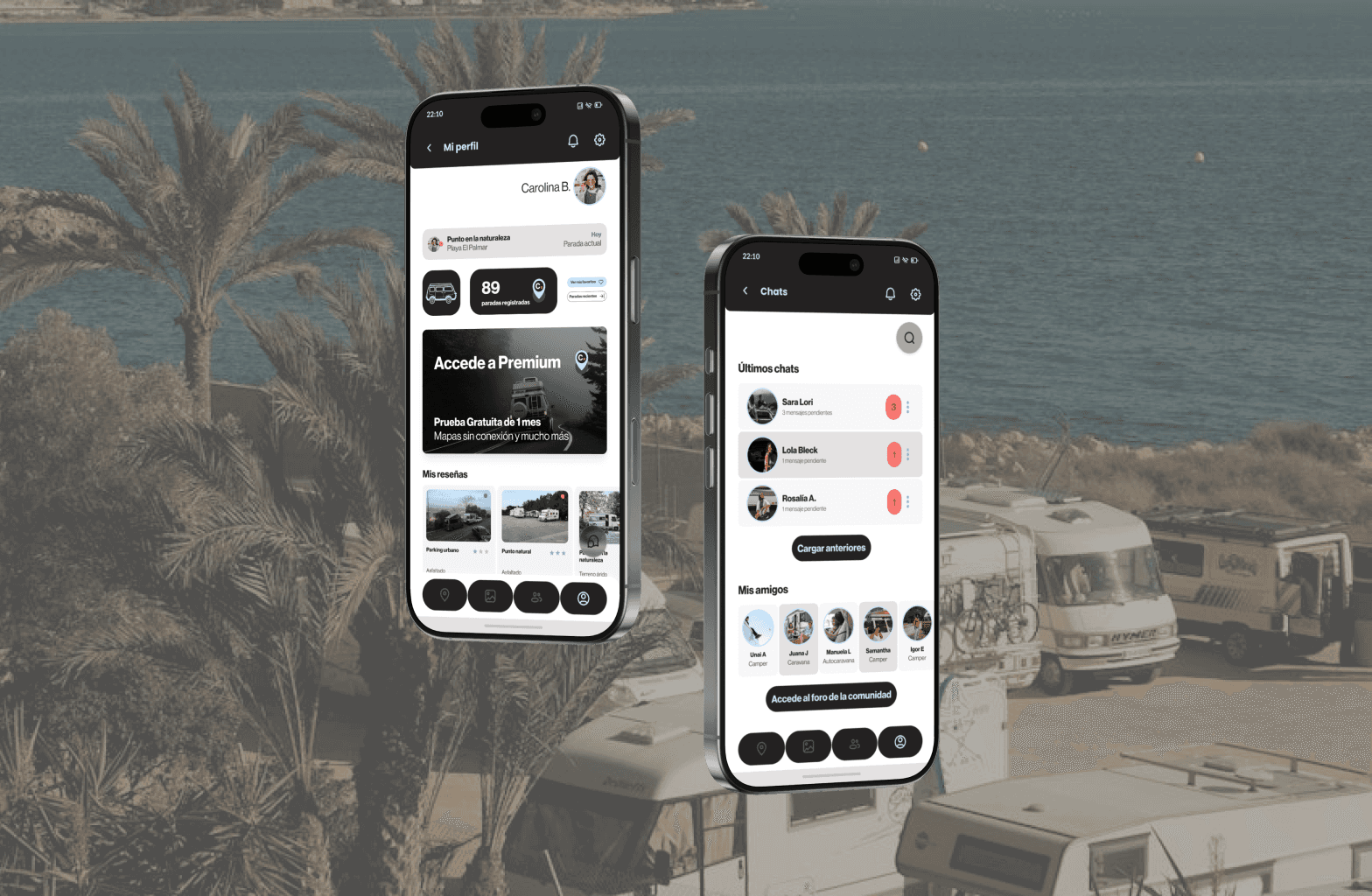
This project, focused on the experience of campervan and motorhome users, presents a unique App that allows users to check in real time the availability of places to stay overnight, something new in the market. It also includes interactive maps with nearby services, practical guides, personalised advice and an active community with forums and chats to connect with other users. With a focus on technology and collaboration, this solution enhances the campervan and motorhome traveller experience.
01 Context & problem
Campervan and motorhome travel keeps growing, but travellers face a real problem: there is no easy way to know, in real time, where they can safely stay overnight. Planning a route means uncertainty, and finding nearby services or trustworthy advice usually means juggling several apps and forums. CamperStop set out to fix this with one app built around real-time availability of overnight spots, a feature previously unseen in the market, bringing the map, services, guides and community into a single connected experience.

02 My Role
I ran this as a comprehensive, self-directed case study and owned every stage: UX research, information architecture, visual design and branding, the design system, the high-fidelity prototype, and the user testing. The whole process took 10 days.


03 Process
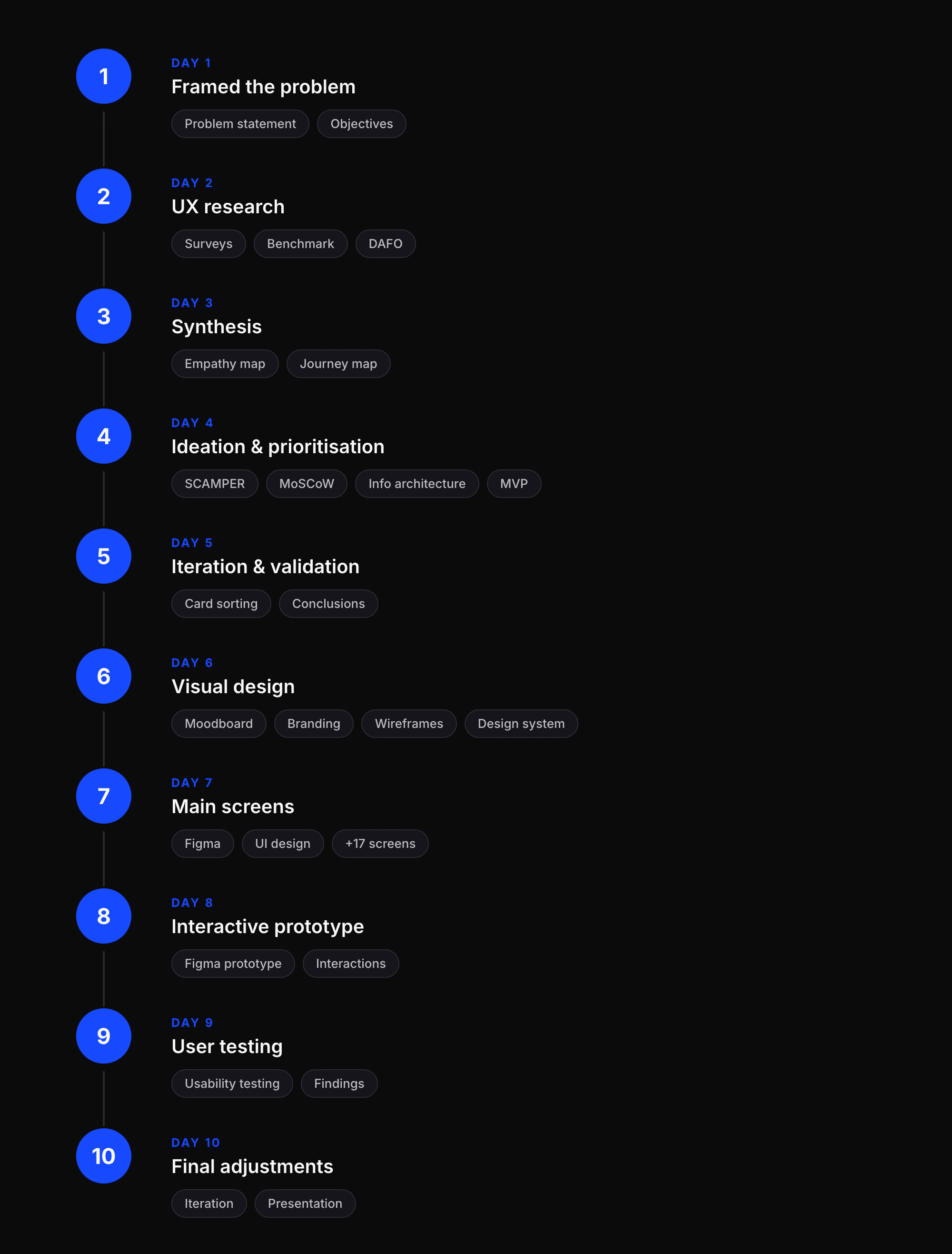
I moved from research to a tested prototype in ten days, keeping each decision grounded in evidence.
04 Solution & key decisions
A mobile-first app with its own brand and design system, designed for clarity, trust and quick decisions on the move.
Full Design Thinking in 10 days
Took a genuinely new idea from research to a tested prototype in a tight, disciplined timeline.
Research-led
Grounded in surveys, a DAFO (SWOT) analysis, a competitive benchmark and card sorting, not assumptions.
Validated with users
Ran user testing on the interactive prototype and fed the findings back into the final design.
Own brand & system
Created the brand identity and a design system, and designed +17 screens on top of it.

05 Impact & learnings
A new idea, taken end to end.
A method for every phase
The most useful lesson was learning which tool actually answers the question in front of you. Surveys and a benchmark to frame the problem, an empathy map and a journey map to make sense of the findings, SCAMPER and MoSCoW to decide what to build, card sorting to validate the structure before spending a single day on visuals. Picking the right method saved far more time than simply working faster would have.
Ten days, with little experience behind me
The hardest part was the pace. Deciding with incomplete information and moving on, rather than polishing. With little experience to fall back on, the methodology itself became what kept the project on track: timeboxing each phase and trusting the process is what got me to a tested prototype instead of a half-finished idea.
A complete, validated concept
A genuinely new idea (real-time availability) carried through the entire process to a tested, high-fidelity prototype in 10 days.
Where I added value
Full end-to-end ownership, research-led decisions, and a design grounded in a proper brand and design system.

Visit also my Behance
Camperstop App
Case Study · Self Directed
App Design
Design Thinking
Prototyping
Real-time overnight spots for campervan travellers
This project, focused on the experience of campervan and motorhome users, presents a unique App that allows users to check in real time the availability of places to stay overnight, something new in the market. It also includes interactive maps with nearby services, practical guides, personalised advice and an active community with forums and chats to connect with other users. With a focus on technology and collaboration, this solution enhances the campervan and motorhome traveller experience.
01 Context & problem
Campervan and motorhome travel keeps growing, but travellers face a real problem: there is no easy way to know, in real time, where they can safely stay overnight. Planning a route means uncertainty, and finding nearby services or trustworthy advice usually means juggling several apps and forums. CamperStop set out to fix this with one app built around real-time availability of overnight spots, a feature previously unseen in the market, bringing the map, services, guides and community into a single connected experience.
02 My Role
I ran this as a comprehensive, self-directed case study and owned every stage: UX research, information architecture, visual design and branding, the design system, the high-fidelity prototype, and the user testing. The whole process took 10 days.
03 Process
I moved from research to a tested prototype in ten days, keeping each decision grounded in evidence.
04 Solution & key decisions
A mobile-first app with its own brand and design system, designed for clarity, trust and quick decisions on the move.
Full Design Thinking in 10 days
Took a genuinely new idea from research to a tested prototype in a tight, disciplined timeline.
Research-led
Grounded in surveys, a DAFO (SWOT) analysis, a competitive benchmark and card sorting, not assumptions.
Validated with users
Ran user testing on the interactive prototype and fed the findings back into the final design.
Own brand & system
Created the brand identity and a design system, and designed +17 screens on top of it.
05 Impact & learnings
A new idea, taken end to end.
A method for every phase
The most useful lesson was learning which tool actually answers the question in front of you. Surveys and a benchmark to frame the problem, an empathy map and a journey map to make sense of the findings, SCAMPER and MoSCoW to decide what to build, card sorting to validate the structure before spending a single day on visuals. Picking the right method saved far more time than simply working faster would have.
Ten days, with little experience behind me
The hardest part was the pace. Deciding with incomplete information and moving on, rather than polishing. With little experience to fall back on, the methodology itself became what kept the project on track: timeboxing each phase and trusting the process is what got me to a tested prototype instead of a half-finished idea.
A complete, validated concept
A genuinely new idea (real-time availability) carried through the entire process to a tested, high-fidelity prototype in 10 days.
Where I added value
Full end-to-end ownership, research-led decisions, and a design grounded in a proper brand and design system.
Visit also my Behance
NEXT PROYECT_
GottaGottaGo App
Camperstop App
Case Study · Self Directed
App Design
Design Thinking
Prototyping
Real-time overnight spots for campervan travellers
This project, focused on the experience of campervan and motorhome users, presents a unique App that allows users to check in real time the availability of places to stay overnight, something new in the market. It also includes interactive maps with nearby services, practical guides, personalised advice and an active community with forums and chats to connect with other users. With a focus on technology and collaboration, this solution enhances the campervan and motorhome traveller experience.
01 Context & problem
Campervan and motorhome travel keeps growing, but travellers face a real problem: there is no easy way to know, in real time, where they can safely stay overnight. Planning a route means uncertainty, and finding nearby services or trustworthy advice usually means juggling several apps and forums. CamperStop set out to fix this with one app built around real-time availability of overnight spots, a feature previously unseen in the market, bringing the map, services, guides and community into a single connected experience.
02 My Role
I ran this as a comprehensive, self-directed case study and owned every stage: UX research, information architecture, visual design and branding, the design system, the high-fidelity prototype, and the user testing. The whole process took 10 days.
03 Process
I moved from research to a tested prototype in ten days, keeping each decision grounded in evidence.
04 Solution & key decisions
A mobile-first app with its own brand and design system, designed for clarity, trust and quick decisions on the move.
Full Design Thinking in 10 days
Took a genuinely new idea from research to a tested prototype in a tight, disciplined timeline.
Research-led
Grounded in surveys, a DAFO (SWOT) analysis, a competitive benchmark and card sorting, not assumptions.
Validated with users
Ran user testing on the interactive prototype and fed the findings back into the final design.
Own brand & system
Created the brand identity and a design system, and designed +17 screens on top of it.
05 Impact & learnings
A new idea, taken end to end.
A method for every phase
The most useful lesson was learning which tool actually answers the question in front of you. Surveys and a benchmark to frame the problem, an empathy map and a journey map to make sense of the findings, SCAMPER and MoSCoW to decide what to build, card sorting to validate the structure before spending a single day on visuals. Picking the right method saved far more time than simply working faster would have.
Ten days, with little experience behind me
The hardest part was the pace. Deciding with incomplete information and moving on, rather than polishing. With little experience to fall back on, the methodology itself became what kept the project on track: timeboxing each phase and trusting the process is what got me to a tested prototype instead of a half-finished idea.
A complete, validated concept
A genuinely new idea (real-time availability) carried through the entire process to a tested, high-fidelity prototype in 10 days.
Where I added value
Full end-to-end ownership, research-led decisions, and a design grounded in a proper brand and design system.